A growler can be a great way to take home a brewery-only pour. It can also be a handsome steel bottle that spends months empty on a shelf because the practical part was never planned. Fresh draft beer has a short, demanding trip from the tap to your glass. The growler is worth buying only when you can make that trip well.
Use a simple same-day test: can the brewery fill it properly, can you keep it cold and upright, and do you have a realistic plan to share or finish the beer soon? If the answer is yes, a growler can turn a good taproom choice into a useful home pour. If one answer is no, cans, bottles, or a smaller crowler are usually the more honest choice.
Begin with the beer, not the container
Not every beer benefits equally from a growler. Crisp lagers, pale ales, and other beers intended for fresh, prompt drinking can be excellent candidates if you will open them soon. Very high-alcohol, barrel-forward, or intensely carbonated beers are not automatically better in a growler; the brewery's own guidance matters more than a style stereotype.
Ask the staff a direct question: "Is this a good beer to take home in a growler, and when would you drink it?" They know their packaging process and turnover. That question is more useful than trying to decode a growler's label or treating the vessel as a guarantee of freshness.
The same freshness judgment applies to every brewery purchase. How To Choose Fresh Beer While Traveling Without Chasing Every Release offers the larger framework: choose the beer you can enjoy well, not the most scarce thing you can carry.
Run the three-part growler test
| Question | A good answer | A warning sign |
|---|---|---|
| Can it be filled well? | The brewery fills and seals the growler, and is comfortable recommending the beer for it | Staff suggests a different package or says it needs to be consumed immediately |
| Can it stay cold and upright? | You are heading home, have an insulated carrier, and can refrigerate it promptly | It will sit in a warm car during other errands |
| Can it be enjoyed soon? | Two or more adults have a meal, tasting, or casual gathering planned within a few days | It is being saved as a collectible or there is no occasion in sight |
Fail any one of those and skip the growler. This is not a moral rule or a test of brewery loyalty. It is a way to respect the beer and avoid buying a volume of draft beer that the next week will not improve.
Choose a size that matches the actual table
The classic 64-ounce growler holds four U.S. pints. That is convenient for a small dinner or a few shared pours, but it is more beer than one person should plan to consume in a sitting. A 32-ounce growler, when the brewery offers it, is often the smarter home size: enough for a comparison or two-person meal, less pressure to empty it quickly.
Choose the vessel around your normal use:
- 32 ounces: the practical default for two adults, a small tasting, or a beer you want to compare beside something else.
- 64 ounces: sensible for a planned group, a family-style meal with adult guests, or a favorite draft beer that will be shared promptly.
- Crowler: useful when you need a one-time sealed package and do not want to carry an empty vessel home.
The growler is not an invitation to turn an ordinary night into a production. Small pours and water on the table make the beer easier to enjoy and evaluate. For a low-key format, see How To Choose Beer for a Small Home Tasting Without Turning It Into a Collection.
Glass, stainless steel, and caps each have a job
A clear glass growler makes it easy to see the fill level and can feel nicely traditional. It also needs more protection from light and breakage. A stainless steel growler is usually the better travel and errand vessel: durable, opaque, and often better insulated. It should still be clean, dry, and free of old aromas before the brewery fills it.
The closure matters more than the aesthetic. A swing-top cap is easy to inspect and reuse; a threaded cap is common and compact. Neither turns a growler into a long-term package. Once opened, carbonation and aroma begin to change. Pour what the table will enjoy and return the rest to the refrigerator promptly, but do not expect an opened growler to behave like a fresh sealed can.
Before a refill, rinse the growler as soon as it is empty and wash it with unscented cleaner. Let it dry completely with the cap off. Old beer residue and detergent perfume are poor companions for a fresh fill. How To Clean Beer Glasses So Foam and Aroma Work Properly has the same useful principle: clean equipment lets the beer speak for itself.
Protect the cold chain on the way home
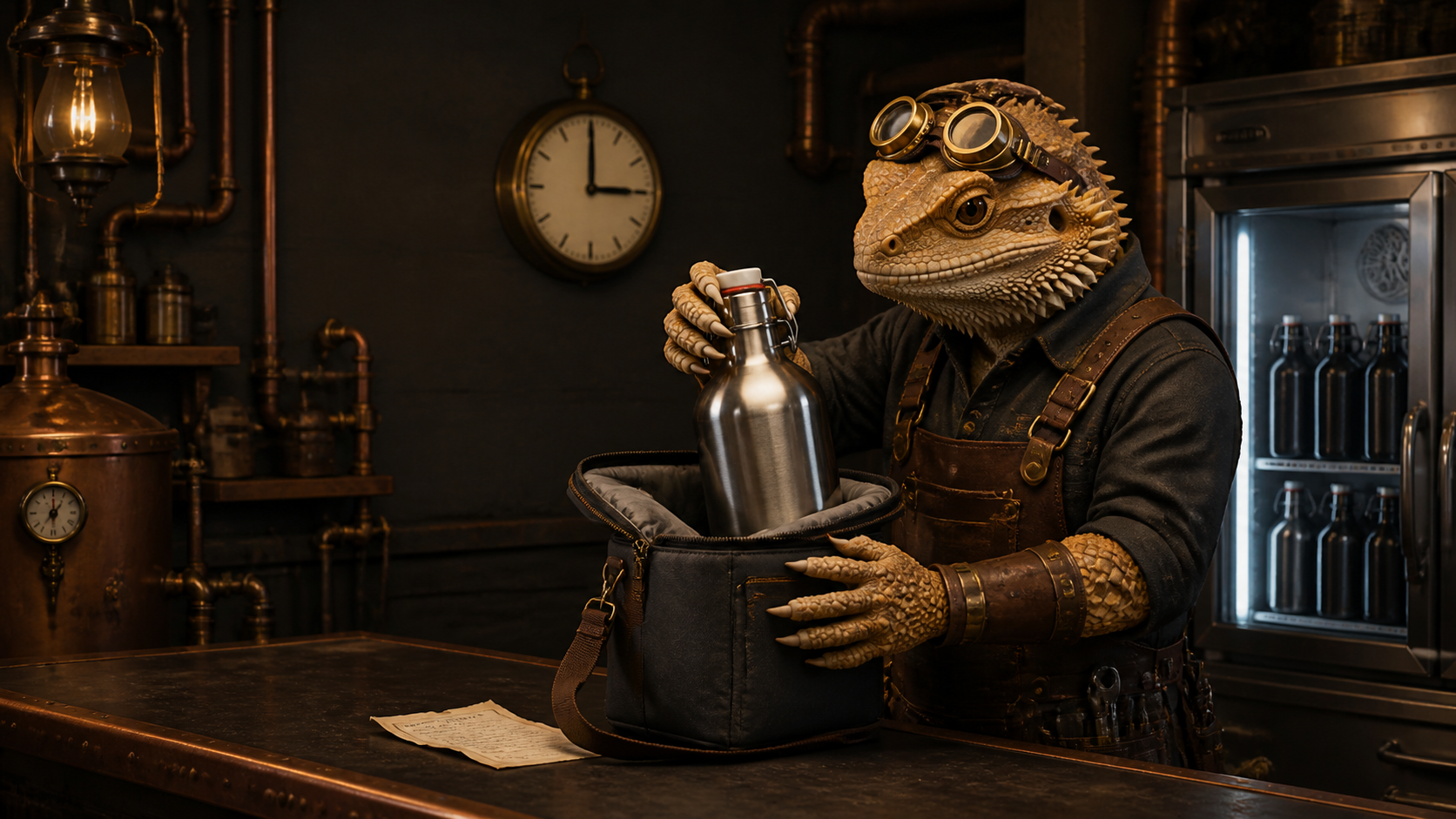
The shortest route is usually the best one. Pick up the growler after the grocery store, not before it. Keep it upright in a small insulated carrier or cooler, out of direct sun, and refrigerate it as soon as you arrive.
Do not leave it in a hot car while you add another stop. Heat and agitation are not a special tasting technique; they are a quick route to disappointed foam, less lively carbonation, and beer that no longer tastes like it did at the brewery. If you are traveling farther than a direct ride home, ask whether a packaged version is the better choice.
Treat a growler as a same-week plan
There is no single universal clock for a filled growler. The brewery's fill method, beer style, refrigeration, and whether it has been opened all matter. The safe practical rule is simpler: buy it for a near-term occasion, store it cold, and enjoy it while the brewery would still recognize it as fresh. Ask at the fill station, then follow their advice.
That approach avoids two bad habits. One is buying a growler because it feels like a souvenir. The other is treating it as a reason to drink more than you planned. A growler is at its best when it gives a small group a good shared pour, not when it creates a deadline for one person.
Bring one home when the whole system is ready
The best growler is not necessarily the prettiest one or the most insulated. It is the right size for a real occasion, filled with a beer the brewery recommends for prompt enjoyment, carried cold and upright, and opened soon with people who will appreciate it.
When that system is in place, a growler is a practical way to extend a brewery visit. When it is not, choose the smaller package, enjoy a fresh pour at the taproom, and leave the shelf ornament behind.