
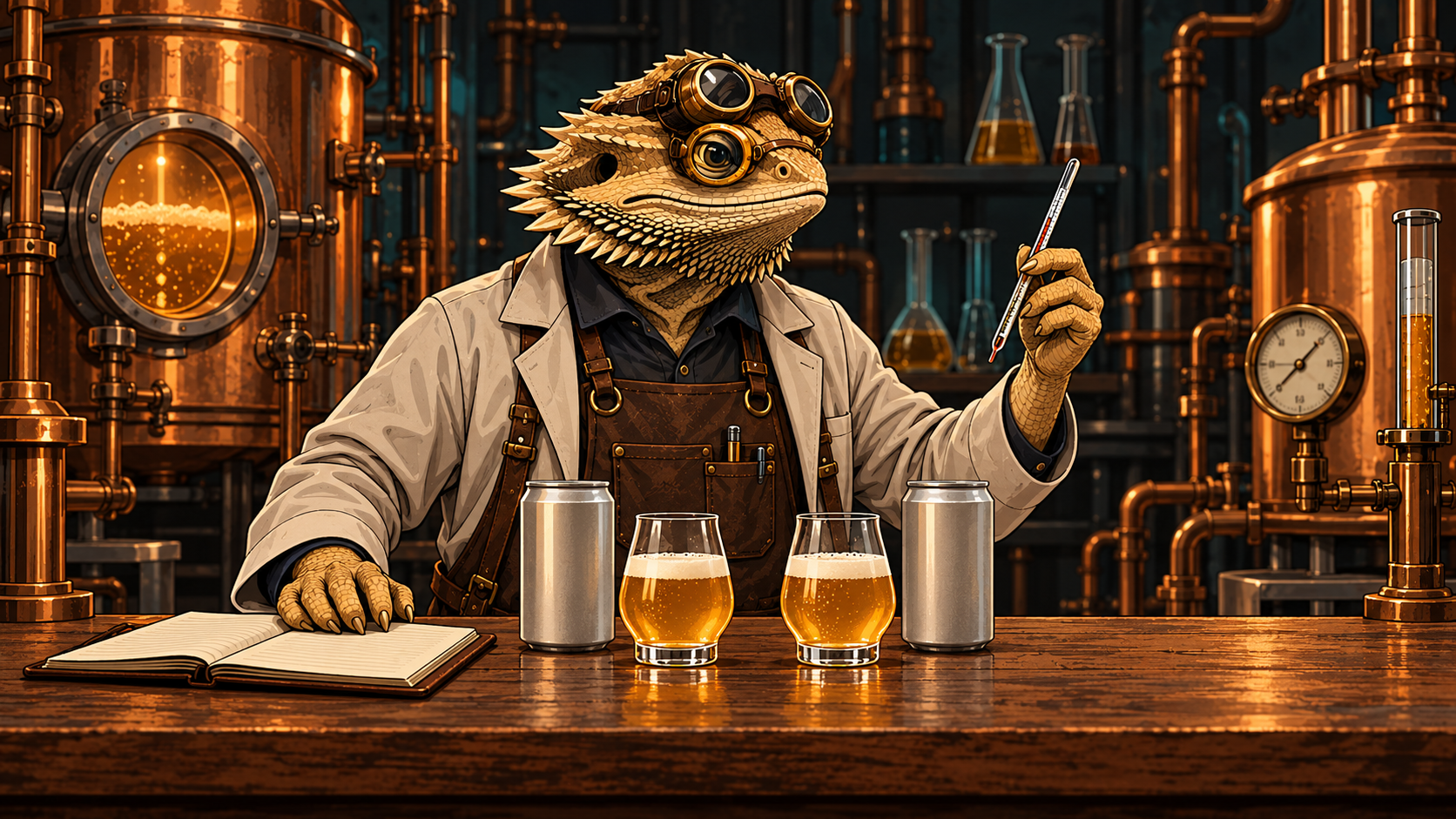
Two cans of the same beer sit on the table. One has a more recent packaging date. Before you open either, your brain has already started writing the results: the newer one will be brighter, the older one will be tired, and the experiment will confirm that checking dates is a clever habit.
Maybe. But if you want to learn something useful, make the comparison a little harder to prejudge. Serve the samples consistently, hide their identities where practical, and write observations before looking at the dates again.
This is a small home comparison, not a brewery stability study. The question is whether you notice a difference between these two packages under these conditions. That is narrower than proving what age does to every can of this beer, but it is a question you can actually investigate.
Choose two packages that make a useful pair
Use the same named beer, preferably in the same package type and size, with two different, readable packaging dates. Avoid comparing a special release with the regular version or a can with a draft fill. Those changes introduce additional explanations before the tasting starts.
Check what each date means. A packaged-on date and a best-before date cannot be subtracted as though they describe the same event. The packaging-date guide covers that distinction. Ask the brewery if a code is unclear; postpone the age comparison if you cannot establish what it represents.
Choose ordinary intact packages that have been stored according to the maker's guidance. Do not deliberately heat, sun-expose, damage, or over-age beer to create a dramatic contrast. Exclude leaking, swollen, or otherwise compromised packages; tasting is not a way to establish their safety.
Two available packages are enough to practice the method. Buying a pile of beer to chase a result defeats the point. Keep the experiment adult-oriented, use small samples, and plan the tasting around your existing limits.
Write down the history you actually know
Before concealing identities, assign each package a private record. Include the beer name, package size, printed code, interpreted packaging date, purchase date, and known storage since purchase. Record where the interpretation came from if you asked the brewery.
Then write the missing information just as plainly. You may not know how long the package spent on a warm shelf, whether distribution routes differed, or whether the recipe changed between batches. “Refrigerated since I bought it” does not mean “continuously cold since packaging.”
Different packaging dates usually mean different production or packaging runs. Ingredient variation, process variation, and package oxygen can differ too. Even a careful home comparison therefore bundles age with several possible causes.
The Brewers Association freshness series identifies oxygen management during production and packaging as a freshness topic; its detailed resources require membership. Sierra Nevada's public freshness explanation describes fading hop character and stale flavors associated with oxidation, and the importance of storage conditions. Those mechanisms explain why history matters. They cannot tell you exactly what happened to either package on your table.
Make serving conditions deliberately boring
The glasses and pour should contribute as little variation as practical. Use two identical, clean, odor-free tasting glasses. Follow the beer-glass cleaning guide if detergent residue, grease, or storage smells are an issue.
Prepare a simple setup:
- Bring both unopened packages to the same intended serving temperature in the same refrigerator.
- Use the same glass shape and similar starting glass temperature.
- Measure equal small samples, such as 60 mL per glass; this is a comparison size, not an instruction to finish them.
- Open and pour close together, using the same glass angle and pouring approach.
- Keep the interval from pouring to observation similar for both samples.
- Use the same lighting, with water available and strong food or room aromas out of the way.
Record your target temperature and any measurement you actually make. You do not need to claim an exact liquid temperature because both cans spent the night in a fridge. If you measure samples, use a clean food-suitable thermometer consistently and avoid contaminating one glass differently.
Do not wait for one sample's foam to disappear while inspecting the other for several minutes. Aroma, temperature, and carbonation continue changing after the pour. A simple shared sequence is more useful than elaborate equipment used inconsistently.
Conceal the package identities if you can
A helper can pour out of sight, assign neutral codes, and keep the mapping until your notes are complete. Use arbitrary codes rather than “fresh” and “old.” Keep the cans and date marks away from the tasting position.
If you are alone, code the glasses and conceal the packages, but acknowledge that you may remember which is which. Do not call that fully blind. The purpose is to reduce obvious cues, not to award the exercise a scientific-sounding label.
For a first pass, inspect both samples, then smell each, then take a small sip from each if you choose to taste. Record the order. On a second brief pass, reverse which sample you assess first so the same glass does not always get your freshest attention.
If several adults participate, have everyone write independently before discussion. Hearing “this one is cardboard” can rapidly become the group's organizing theory. There is plenty of time to compare descriptions afterward.
Use a blank observation sheet
Copy this sheet before opening the packages. The package mapping stays separate until the first observations are finished. These are fields to fill, not reported results.
Beer / package type and size:
Session date / room conditions:
Target serving temperature /
  actual measurement, if any:
Glass type / sample volume /
  pour method:
Pour times / first observation
  times:
First-pass order / second-pass
  order:

Sample code:
Appearance and foam:
Aroma, in ordinary words:
Flavor and finish, if tasted:
Carbonation and mouthfeel:
Difference noticed compared with
  other sample:
Preference / no preference:
Confidence and distractions:

Repeat the sample fields for the
  other code.

After reveal:
Code-to-package mapping /
  packaging dates:
Known storage history for each:
Unknown history / possible batch
  differences:
What this comparison supports:
What remains unresolved:
Use descriptions you can defend. “Less citrus aroma than the other sample” is more useful than “severely oxidized” when you have no measurement or diagnostic evidence. The home tasting-notes guide offers more help with plain-language observations.
Interpret the reveal without upgrading the evidence
Read your notes before revealing the dates. Separate three questions: did you notice a difference, did you prefer one sample, and what might explain it? Those questions can have different answers.
You might notice a difference without a preference. You might prefer the older package. You might find the samples indistinguishable. None of those outcomes needs fixing. A home experiment that permits only the expected answer is just a demonstration with extra dishes.
Two coded glasses do not establish statistical significance or reliable identification. Repeated sips from the same pair are not independent package samples. Several tasters sharing those packages still leave you with only two packages and their particular histories.
Write a bounded conclusion: “I noticed this difference in these samples under this setup,” or “I could not confidently distinguish them.” Avoid turning either into “this beer lasts exactly this many days.” An aroma comparison also cannot establish food safety, contamination status, or remaining shelf life.
Make the next comparison better, rather than bigger
If you repeat the exercise another day, retain the method and use newly opened packages. Leftover beer adds an after-opening variable. Record the new dates and histories instead of treating a second session as an exact replication of the first.
A more focused follow-up might use packages from one batch stored under the same recommended conditions and compared at planned intervals. That reduces some variation but still requires independent packages, consistent serving, and restraint about what the observations prove. You do not need to turn the refrigerator into a sample archive.
Use the findings to ask better purchase and storage questions, then return to the home-storage guide for handling decisions. There is no obligation to finish the samples or the remaining packages.
The useful result is a better observation habit: control what you can, disclose what you cannot, and let the notes precede the explanation. That makes a modest side-by-side tasting more informative without pretending it can settle beer freshness for everyone.