
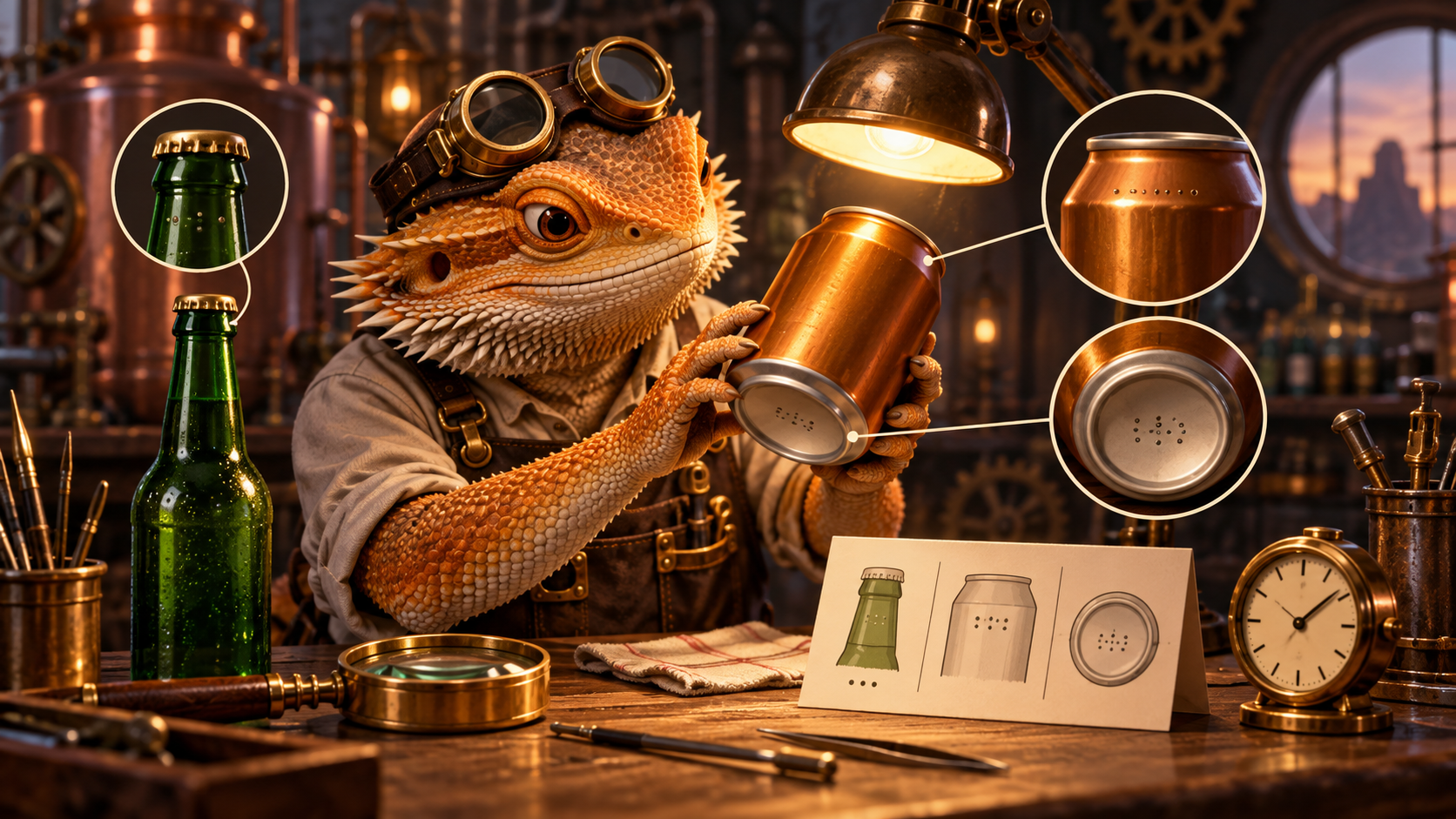
A date on a beer can looks like an answer until you ask what the date means. Was the beer packaged that day? Is that the brewery's preferred last day for sale? Is the line a batch code that only the producer can decode? A neat row of numbers can look precise while telling a shopper almost nothing without the brewery's convention.
Beer dates are useful evidence, not a universal expiration clock. The Brewers Association's draught beer quality guidance describes packaged-on, best-before, pull-date, and other coding systems, and notes that freshness windows vary by brand. The lesson carries into the store: identify the kind of mark before turning it into a judgment about a can or bottle.
This is a purchase-time guide. Once the beer is home, How To Store Beer at Home Without Ruining It covers the separate problem of protecting what you bought.
Find the mark before interpreting it
Check the bottom or side of a can, the neck or label of a bottle, and any outer pack that the producer uses. A multipack carton may carry useful information, but confirm that it belongs to the individual packages inside. Printing can be faint, rotated, partially obscured by a label, or hard to read under store lighting. Take a moment to look rather than guessing from a display sign.
Three broad kinds of information appear:
| Mark | What it can tell you | What it cannot tell you alone |
|---|---|---|
| Packaged on | When the beer entered that package, if the producer labels it clearly | Its intended quality window or how it was handled since packaging |
| Best before or best by | The producer's quality target for that beer under its assumptions | A precise moment when the beer becomes unsafe or suddenly tastes bad |
| Lot or batch code | Which production run the brewery can trace; sometimes it embeds a date | A consumer-readable date unless the producer explains the code |
The same printed date can mean opposite directions of time. “PACKAGED 08/15” tells you when the clock started. “BEST BEFORE 08/15” tells you the producer's target end of a window. If a number appears with no label, neither reading is safe. Month and day order, two-digit years, and Julian-style codes add more ways to get it wrong.
The practical rule is simple: first read the words around the mark. If there are none, look for the brewery's own explanation or ask the retailer. Do not borrow a decoding chart for a different brewery because the string looks familiar.
A packaged-on date is a start point
A packaged-on date gives you the most direct answer to “How long has this beer been in the can?” It does not give you a universal deadline. A hop-forward beer whose appeal is fresh aroma may deserve a shorter purchasing window than a strong, malt-forward beer made for slower change. The producer's process, packaging quality, distribution, and storage matter too.
Consider two cans of the same beer in the same refrigerator, one packaged recently and one several months earlier. If both were handled similarly and you want the brewery's fresh-hop expression, the newer can is the sensible choice. Now compare a recently packaged can that sat warm in a bright store window with an older one kept cold. The date alone no longer settles the question. Heat can accelerate flavor change, and light exposure matters especially for beer in susceptible bottles.
Use the date to compare like with like: same beer, same producer, similar storage. If you cannot see how a shop handled the package, treat that uncertainty as part of the decision rather than making up a shelf-life number. Sierra Nevada's explanation of beer dates and storage distinguishes packaged-on from best-by and describes how style, packaging, and temperature affect quality.
Best-before is a quality claim, not a magic switch
A best-before date is the producer's estimate for the beer's intended quality. It is useful because the brewery knows what it packaged and what character it wants the drinker to experience. It is not an assurance that every bottle was kept cool, and the beer does not transform at midnight on the printed date.
Compare the date with the way the beer was offered for sale. A can well within its stated window but sitting warm in direct sunlight is a weaker bet than the same beer kept cold. A package past its best-before date may still be drinkable, but a buyer paying full price for the intended flavor has a reasonable reason to choose a fresher one or ask for a discount. Do not treat a quality date as a food-safety certification; if a package is leaking, swollen, damaged, or otherwise suspect, leave it behind regardless of the date.
Some styles are intentionally made to evolve. That does not make every old beer a cellar candidate. A beer intended for aging should come with a plausible producer rationale and suitable storage, not merely an old sticker and a hopeful story from the shelf. Buy the beer for what it is meant to be, not for a generic theory that older means more interesting.
A code can be useful without being self-explanatory
Many marks serve traceability first. A brewery may use letters for a line, numbers for a batch, and an internal date format that changes between products. Even an obvious-looking number can be a lot identifier rather than a best-before date. The Brewers Association's food-safety planning guide notes that consumers may not recognize a coded or Julian date and that even a familiar date format needs a label to say what it represents.
If the brewery publishes a code guide, use that guide. If it does not, take a clear photo and ask the producer or a knowledgeable retailer. Include the beer name and the full mark; trimming off a letter can remove the part that identifies a packaging line or year. If the answer is unavailable and freshness is central to the beer you want, choose a package with clearer information. You do not owe a mystery code the benefit of the doubt at a premium price.
Avoid internet folklore such as “the first three digits are always the day of the year.” That may describe one producer's scheme and misread another's. A useful convention is one the actual brewery confirms.
Make the purchase decision in four passes
You do not need to conduct a forensic examination in the beer aisle. Use a short sequence:
- Name the beer's goal. Are you buying a bright, hop-driven beer for its aroma, an everyday lager for crispness, or a specialty beer the brewer expects to develop?
- Identify the mark. Read packaged-on and best-before labels literally; decode an unlabeled string only with the producer's help.
- Check handling clues. Look for refrigeration when appropriate, protection from light, intact packaging, and a store that rotates stock.
- Compare the available options. Choose a better-supported package of the same beer, ask a question, or buy something else if the evidence is weak.
The sequence is deliberately conservative. It protects you from two bad habits: rejecting a good beer because it missed an arbitrary online age limit, and buying a tired one because the code looked reassuringly technical.
For a hop-forward beer, I would put more weight on a clear recent packaged-on date and cold handling. For a specialty bottle intended to change with age, I would put more weight on the producer's guidance and the shop's storage practices. In either case, a date is a clue about the beer's path to your glass, not the whole path.
Ask for clarity, not a universal rule
Good date information makes beer easier to buy with confidence. A clear packaged-on label, an understandable best-before date, or a brewery that explains its code helps shoppers choose the product as intended. When the label is opaque, the honest response is to seek the producer's meaning rather than invent one.
At the shelf, decide what flavor you are buying, read the mark on its own terms, and judge the visible handling around it. Then take the beer home and store it well. That is more useful than pretending every style, brewery, and package expires on the same schedule.