
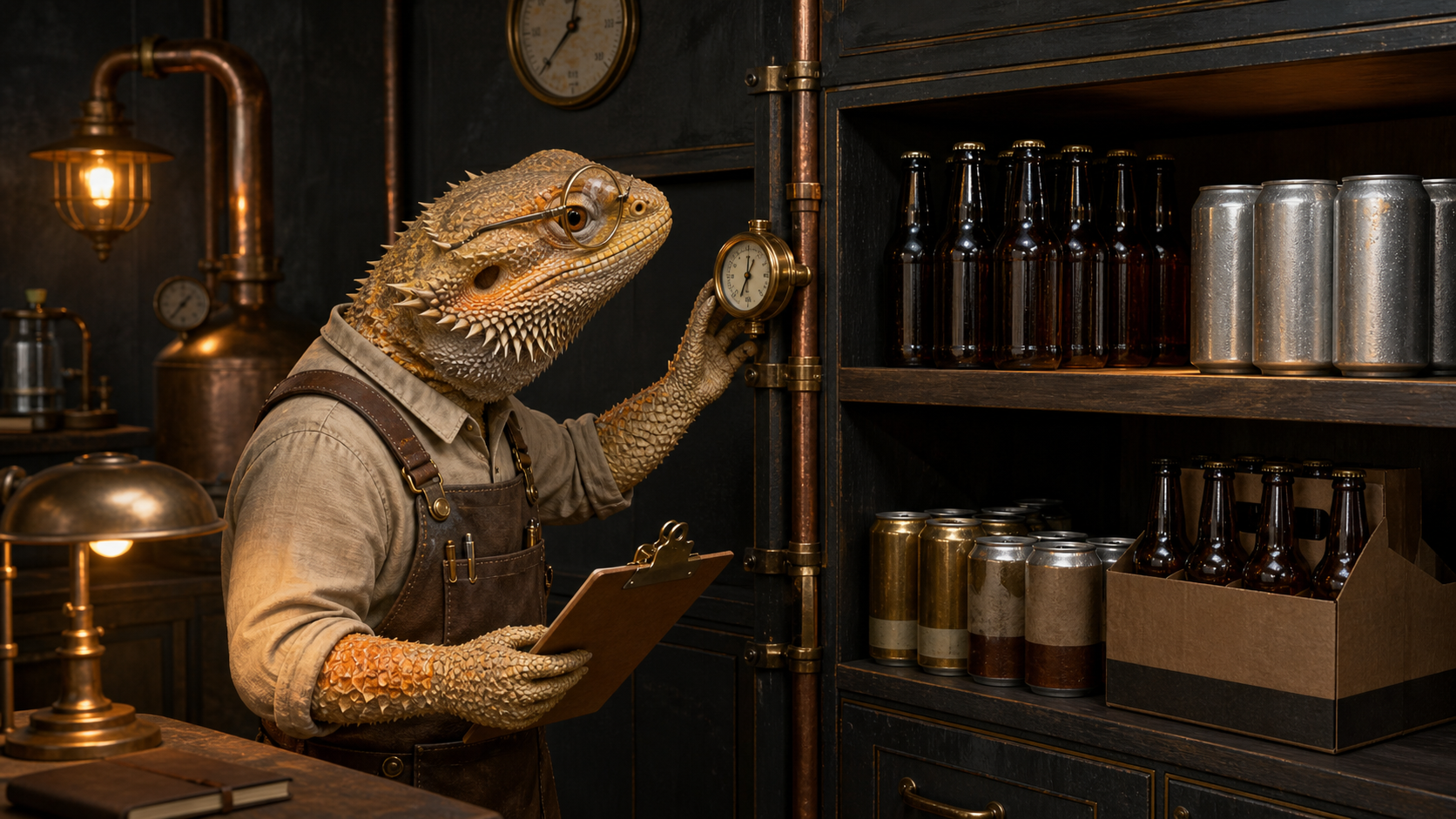
Most beer does not need a cellar. It needs to be left alone in a cool, dark place until you are ready to drink it.
That deliberately boring answer is useful because beer storage advice often swings between two unhelpful poles. One says every beer must live at refrigerator temperature from the second it leaves the store. The other treats every bottle as a future treasure that needs a special rack, handwritten inventory, and years of patience. Most beer is neither fragile laboratory material nor a collectible. It is a perishable food product with a style, a packaging date, and a better or worse path to your glass.
The home-storage system is simple: protect beer from heat and light, keep it upright, use the freshest beer first when freshness matters, and age only the beers that have a credible reason to change well. The details matter because the useful choice is different for a dry-hopped IPA, a pilsner, a strong stout, and a mixed-fermentation beer.
The four variables that matter most
Beer changes after packaging. The goal is not to freeze it in time; it is to avoid accelerating changes you do not want.
Temperature
Warm storage speeds many staling reactions. A warm car, sunny kitchen shelf, garage with large daily swings, or appliance top is a poor long-term home for beer. Stable cool storage is usually better than a cycle of cold, hot, and cold again.
For ordinary beer you plan to drink soon, refrigeration is a simple, dependable choice. A cool interior closet or basement can also work for beer that does not need to be ready-to-pour immediately, provided it stays reasonably stable and does not get hot. Do not optimize around an exact universal temperature; the direction is more important than false precision.
Light
Light is a particular problem for hop-derived compounds. Clear and green bottles offer less protection than brown bottles, while cans and opaque packaging block light well. The relevant practical rule is not a packaging purity test. Keep all packages out of direct sunlight and bright display lighting. A windowsill is not beer storage, even if the bottle is brown.
Time
Time is not a single good or bad variable. It depends on what the brewer made. Fresh hop aroma, delicate malt, and crisp carbonation are often the point of a pale ale, IPA, helles, or lager. A strong, malt-forward beer may develop more slowly and sometimes interestingly. Use date information when the brewery provides it, and prefer the package you are likely to enjoy in the beer's intended window.
Position
Store beer upright. In bottles, that keeps sediment where it belongs and reduces the liquid's contact with the cap or closure. It also makes a shelf easier to inspect, rotate, and move without turning a collection into an accidental experiment. Cans should be upright for the same practical reasons: stable stacks, legible dates, and fewer surprises when you open them.
Store by intent, not by packaging type
The useful question is not “can or bottle?” It is “what is this beer trying to be when I open it?”
| Beer type | Sensible home-storage approach | Why |
|---|---|---|
| IPA, pale ale, dry-hopped beer | Refrigerate and drink relatively soon | Hop aroma and bright flavor are central to the style. |
| Pilsner, helles, wheat beer, ordinary lager | Keep cool; refrigerate when practical | Freshness, crispness, and carbonation matter. |
| Amber, brown, porter, standard stout | Cool and dark; no need for drama | These can be less fragile but are rarely improved by neglect. |
| Strong stout, barleywine, Belgian strong ale | Cool, dark, stable; consider aging selectively | Higher strength and malt complexity can make slow change interesting. |
| Sour, wild, bottle-conditioned beer | Follow brewery guidance; store upright and cool | The producer's intended condition and package matter. |
This is a decision guide, not a promise. A brewery's own packaging and storage guidance outranks a generic style rule. A fresh IPA might be excellent six weeks after packaging if it was cold through distribution; a beer can also be tired much sooner after a hot retail shelf. Dates are useful evidence, not a verdict written by a calendar.
Refrigeration is a tool, not a religion
If you have fridge space, it is reasonable to use it for beer you expect to drink over the next few weeks. It keeps temperature low and stable, makes an impromptu pour easy, and removes the temptation to leave a fresh four-pack on a warm counter.
The tradeoff is capacity and serving temperature. A beer taken straight from a very cold refrigerator can hide aroma and flavor, especially for stronger or darker styles. That is a serving issue, not an argument for warm storage. Let the poured beer warm slightly in the glass if the style benefits, rather than storing the whole package in a warm room for months.
For a small home setup, the best answer is often a simple rotation: keep the next few fresh beers in the refrigerator, keep longer-hold bottles in a dark, stable cabinet, and do not buy more than your storage system can treat well.
Do not build a beer cellar out of anxiety
Aging is real, but it is not a general upgrade. Some strong, malt-forward, high-alcohol, sour, or bottle-conditioned beers can change in appealing ways. Fruit may recede, oxidation notes may become more apparent, carbonation may evolve, and the beer can become more integrated—or simply less vivid. That uncertainty is the point. Aging is a small experiment, not a purchase justification.
If you want to age a beer, make it controlled:
- Buy two or three bottles, not a case you feel obligated to finish.
- Keep one to drink near release as a baseline.
- Store the others upright, dark, and temperature-stable.
- Label the purchase or package date if it is not already visible.
- Taste one at a planned interval and write down a few observations.
That method gives you information about a specific beer without declaring that every stout or Belgian ale needs a five-year plan. It also keeps responsible enjoyment intact: a collection is not a reason to rush through beer, and aging is never a reason to ignore how you will get home.
The home-storage mistakes worth avoiding
- Leaving beer in a hot car. This can do more harm in an afternoon than modestly imperfect pantry storage does in a week.
- Using a sunny display shelf. It looks good until light and temperature become part of the beer's recipe.
- Buying hoppy beer faster than you drink it. A huge refrigerated backlog is still a backlog.
- Storing bottles on their sides. This complicates sediment and closure contact without helping ordinary beer.
- Treating every old beer as cellar-worthy. Age can produce nuance, but it can also produce a tired beer.
- Forgetting the retail path. A recent package date is encouraging, but it cannot prove cold handling before the beer reached you.
The same systems thinking explains Why Beer Tastes Better at the Brewery. A shorter, better-managed path from package to glass is often an advantage, not a mystical property of the building.
A simple weekly beer rotation
You do not need an app or a cellar ledger to keep beer in good shape. Once a week, look at what is in the refrigerator and cabinet. Put the freshest hop-forward or delicate beer near the front. Keep special bottles upright in the darker, more stable section. Move a beer to the refrigerator when you intend to drink it soon. If something has sat long enough that you are unsure why you bought it, make a conscious decision: drink it, save it for a planned comparison, or stop buying that much at once.
When it is time to open a bottle or can, a clean glass and sensible temperature matter more than a theatrical ritual. The Only Beer Glasses Most People Actually Need is a practical starting point, and One IPA, Four Glasses: Can You Taste the Difference? shows how to test a glass preference without turning it into dogma.
The practical answer
Store beer cool, dark, upright, and in quantities that match how you actually drink it. Refrigerate fresh, hop-forward beer when practical. Keep potential aging candidates stable and modestly organized. Let the brewery's guidance and the beer's style matter more than generic rules about cans, bottles, or “cellaring.”
The point is not to make a home beer shelf precious. It is to protect the beer you chose long enough to enjoy what the brewer intended.