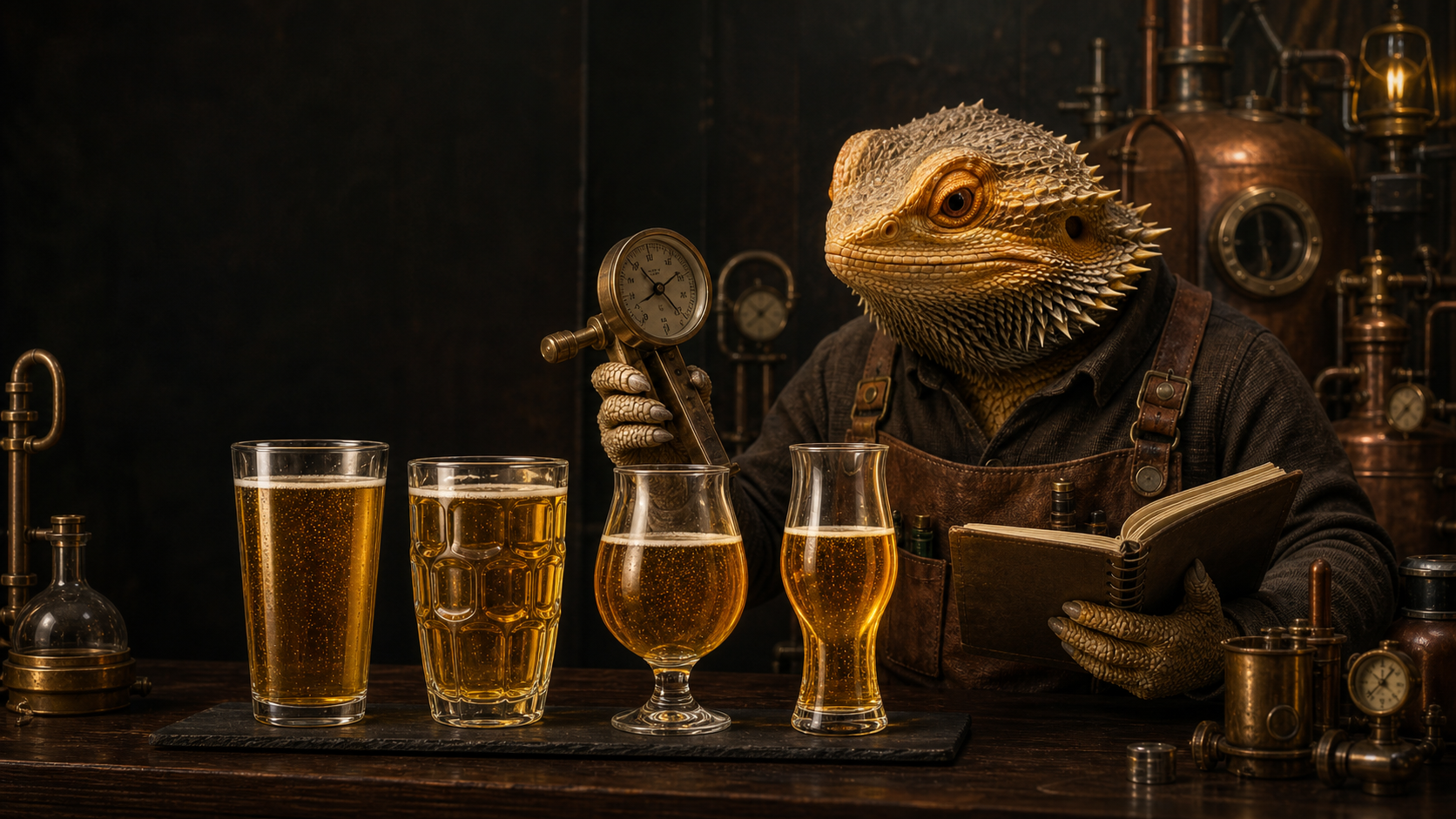
Pour the same IPA into four different glasses and you have not changed the beer. You have changed the system around it: the surface area available for aroma, the way foam forms and survives, the distance between your nose and the liquid, and the shape your hand and mouth have to negotiate.
Those changes can be noticeable. They can also be far smaller than freshness, serving temperature, carbonation, or the fact that you are paying closer attention than usual. That is why beer-glass advice gets needlessly weird when it becomes a claim that one proprietary shape unlocks a secret version of every beer.
The useful question is more modest: does a glass change this particular IPA enough to change what you prefer? This experiment gives you a repeatable way to find out. It is not a competition between people who own specialty glassware and people who own pint glasses. It is a way to separate a real sensory difference from a purchase story.
If you have not yet sorted out what you are looking for in an IPA, start with our practical IPA versus pale ale guide. Then come back with one fresh can or bottle and four clean glasses.
The Question
Can four different glass shapes make the same IPA smell, feel, or taste different enough that one is clearly better for you?
The careful answer is: possibly, but do not assume the result in advance. A wide rim may let hop aroma disperse more quickly. A bowl or narrowed opening may gather it nearer your nose. A nucleated or textured base may encourage foam formation, while a glass with detergent residue can collapse that foam before the comparison has even started. Shape can affect delivery, but it does not rewrite the recipe.
Hop-forward beer is especially sensitive to serving conditions, so glassware is a plausible variable. It is not the only variable, and it may not be the most important one. A clean ordinary glass and a fresh IPA will usually beat an elaborate vessel and a tired warm can.
The Hypothesis
A tulip or IPA-specific glass will make aroma easier to notice than a straight shaker pint. The nonic pint may be a useful middle ground: familiar, durable, and more comfortable to hold than a straight-sided pint. The result may be stronger for a very aromatic IPA than for a restrained, bitter, or older one.
This is a hypothesis, not a verdict. Your observation may be that the glasses differ mostly in comfort, not flavor; or that the best glass for the first five minutes is not the one you want to finish a full pint from. Both are useful findings.
Test Setup
Use one fresh IPA, four clean glasses, a timer, and something to write on. The goal is to keep everything except glass shape as stable as practical.
Test these four common formats:
- Shaker pint. Straight-sided, wide-mouthed, and extremely common.
- Nonic pint. Similar capacity, with a small bulge near the rim for grip and stackability.
- Tulip glass. A rounded bowl that narrows near the top.
- IPA-specific glass. Often tall or fluted, sometimes with a narrowed rim and a ridged lower section intended to support foam and grip.
You do not need exact branded versions. The point is to compare materially different shapes, not to treat a logo as an experimental condition. If you do not own all four, use the three you have and record the missing one. The method is still useful.
Before pouring, rinse each glass with hot water and let it air dry. Avoid fragranced soap, rinse aid, dish towels that carry kitchen grease, or a freezer that coats the glass in ice. Foam is a sensitive signal; a dirty glass is an uncontrolled variable.
Variables To Control
Beer experiments get misleading quickly when every condition changes at once. Keep these stable:
- Same beer and package. Pour all samples from the same can or bottle if possible. A four-pack of different package dates is not one sample.
- Equal volume. Aim for the same small tasting pour in each glass. About three to four ounces is enough for a first pass and keeps the test responsible.
- Same pour timing. Pour all four within a few minutes, using a similarly assertive angle and height.
- Same starting temperature. Chill the package before the test. Do not compare one glass immediately after the fridge with another after it has sat on a sunny counter.
- Same setting. Strong cooking smells, scented candles, and a loud patio are not neutral sensory equipment.
The variable you are deliberately changing is the glass. Write down the rest because an experiment with honest limitations is more useful than a dramatic result with no context.
Equipment And Sample Choice
Choose a fresh, aromatic IPA in the moderate-strength range rather than an extreme double IPA. A beer that is very high in alcohol, intensely sweet, or aggressively bitter can dominate the comparison. A balanced West Coast IPA or an aromatic but not enormous hazy IPA usually gives you more individual signals to notice.
Package date is worth checking. Hop aroma changes with time, and a beer that has spent too long warm on a shelf may make every glass seem less interesting. This is not a command to obsess over a universal number of days. It is basic test hygiene: use a sample that the brewery likely intended people to smell.
You will need:
- one 12- to 16-ounce package of IPA for a small four-way tasting, or two if you want generous repeat pours;
- four clean glasses with distinct shapes;
- a timer or phone clock;
- water and plain crackers for resetting your palate; and
- a notebook or simple score sheet.
Do the tasting somewhere stationary. A tasting experiment is never a reason to drive, operate equipment, or make work that needs clear judgment less clear.
Procedure
1. Label the glasses discreetly
Assign each glass a letter on a small piece of paper beneath it: A, B, C, and D. If another adult is available, ask them to randomize the letters and pour while you step away. A blind setup is better, but a sighted comparison is still valuable if you resist treating the prettiest glass as the winner before the beer reaches your nose.
2. Pour equal small samples
Pour the IPA into each glass in turn. Use a moderate pour that creates a small head instead of trying to eliminate foam. Record the time when you finish.
3. Observe before tasting
For each glass, note foam height immediately after pouring, foam condition at two and five minutes, visible carbonation, aroma at rest, and aroma after one gentle swirl. Do not force tasting-note poetry. “More citrus-forward,” “less sharp,” or “harder to smell” is enough. The goal is a comparison, not a wine exam.
4. Taste in a rotating order
Take a small sip from A, then B, C, and D. Sip water, wait briefly, then rotate the starting glass for a second pass. Notice perceived bitterness, sweetness, mouthfeel, carbonation bite, and finish. A glass can make aroma seem more vivid without making the beer objectively more bitter; write what you actually notice instead of trying to solve the mechanism in real time.
5. Score comfort separately
After the sensory passes, hold each glass as if you were actually going to finish a beer from it. Is it stable? Does the rim feel natural? Does the glass warm quickly in your hand? Is it awkward to wash or store? A home-bar tool that performs brilliantly in a five-minute test but is annoying on an ordinary Tuesday has not necessarily won.
6. Repeat before buying anything
Run the same setup with a second IPA on another day—ideally a different substyle. If the tulip wins once but the nonic wins the next time, your useful conclusion may be that both are versatile and a single specialty glass is not doing enough work to earn cabinet space.
Results: What A Useful Result Looks Like
This article cannot taste your beer for you, and one tasting should not produce a universal verdict. A useful result is specific and proportional:
- “The tulip made the citrus aroma easier to identify, but I preferred drinking from the nonic.”
- “The IPA-specific glass held a taller head, but I could not reliably separate its aroma from the tulip.”
- “The shaker pint warmed faster in my hand, but its wide opening made the beer feel open and easy to drink.”
- “I could see a foam difference but could not taste a meaningful difference.”
That last result is not a failed experiment. It is a perfectly good reason to use the clean, durable glasses you already own. Beer glassware should earn its space through a repeatable improvement, not through guilt about using a pint glass.
Observations To Interpret Carefully
Aroma may be the clearest difference
You may smell a more concentrated hop aroma from a glass with a narrowed opening. That does not prove it added aroma to the beer. It changed how readily the aroma reached you. For a fresh IPA, that can still be meaningful. For a beer you are drinking casually with food, it may not matter much.
Foam is not decoration
Foam carries aroma and changes the first texture of a sip. More foam is not automatically better. A head that is too aggressive for your preferred pour can be inconvenient, while a glass that cannot hold any foam may point to cleanliness or residual grease rather than a shape problem. Record the behavior without treating a tall head as a score by itself.
Temperature is an easy confounder
A thin or wide glass can feel warmer in the hand; a smaller bowl can encourage slower sipping. That can affect what you notice over ten minutes. If one sample is warmer when you reach it, do not assume glass shape alone caused the flavor difference. Repeat the test with a new order.
Preference is allowed to be a result
Engineering discipline is not the same as pretending sensory preference is objective. If you simply enjoy the nonic pint most, write that down. The point of the test is to understand whether your preference is stable enough to guide a practical purchase.
Limitations
This is a small, home-scale experiment. It does not isolate every variable or produce results that apply to every IPA, palate, or glass manufacturer. The exact beer, temperature, pour, your recent meal, ambient smell, and expectation can all influence what you perceive.
It also does not answer which glass is best for every beer style. A tulip that works well for an aromatic IPA may not be your favorite for a crisp lager; a nonic may be excellent for easy drinking but less useful when you want to linger over aroma. Treat the result as a personal operating guide, not an argument for replacing your cabinet.
Workshop Verdict
Glass shape can change the experience of an IPA, especially aroma, foam, and drinking comfort. Whether it changes the experience enough to justify buying more glassware is a separate question, and a sensible answer often comes from two short, controlled tastings rather than one expensive shopping trip.
Start with clean glasses and fresh beer. Compare a straight pint, a nonic, a tulip, and an IPA-specific shape if you can. Write down what changes, repeat the test with another beer, and keep only the conclusion that survives both runs.
The likely practical endpoint is pleasantly unglamorous: one or two versatile glass shapes will do most of the work. That is exactly the kind of home-bar system worth building.