
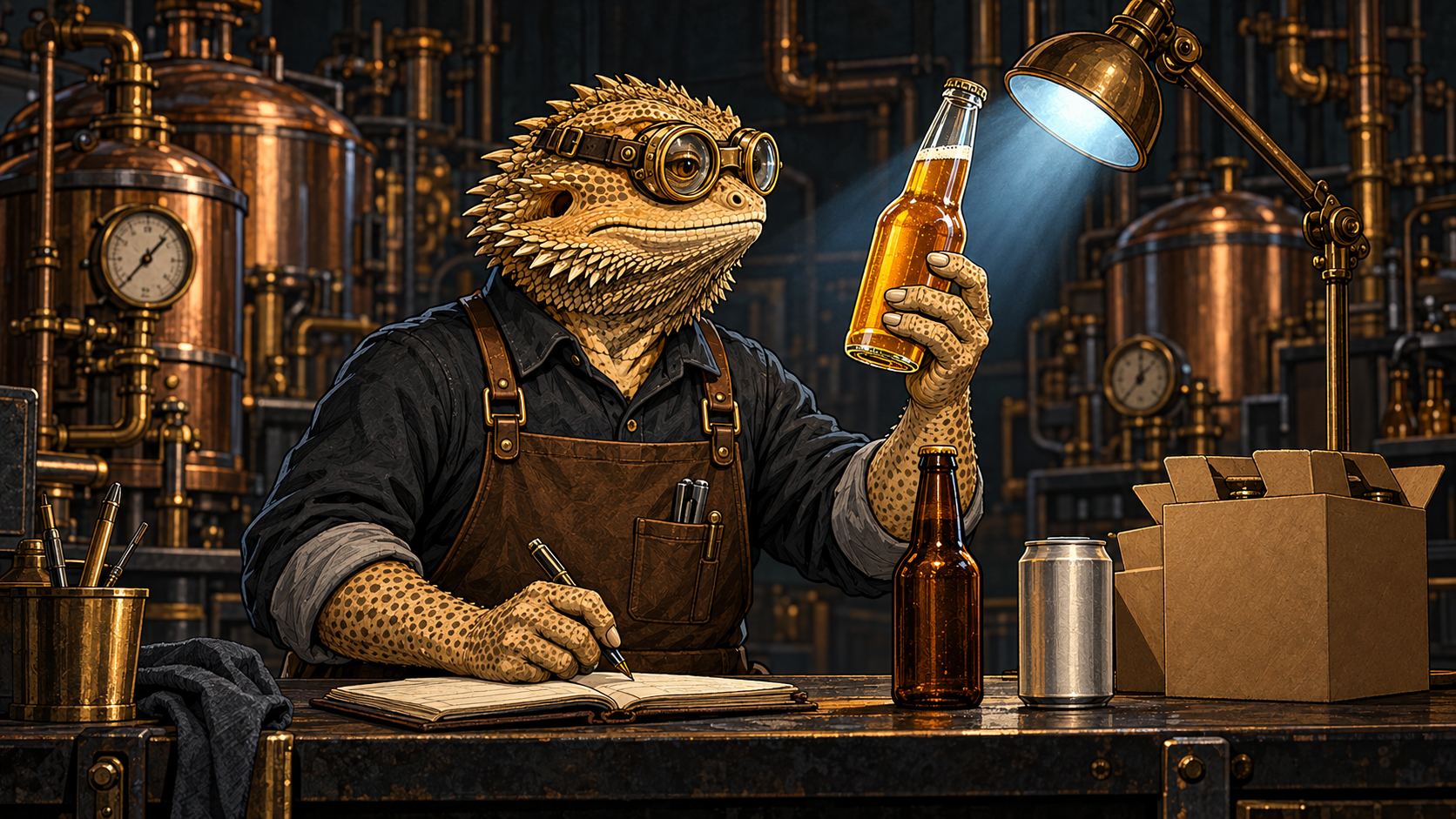
A beer can be cold, recently packaged, and still carry an aroma you associate with a skunk. Those observations are not contradictory. Temperature, age, and light exposure describe different parts of the beer's history.
Light-struck beer is beer whose flavor has been changed by light-driven chemistry. The familiar skunky character has a specific chemical explanation; it is not a catch-all name for every disappointing bottle. Understanding that explanation makes packaging choices and serving decisions much easier to judge.
My practical preference is straightforward: protect the beer from unnecessary light, then evaluate freshness separately. A can has an excellent light barrier while sealed. That does not tell you whether its contents spent months in a warm warehouse. A brown bottle provides useful protection. It is not an invitation to display beer indefinitely in a sunny window.
The reaction starts with light and brewing ingredients
Hops contribute alpha acids, which become iso-alpha acids, also called isohumulones, during conventional wort boiling. Those compounds supply much of beer's characteristic bitterness. They also participate in the chemistry behind classic light-struck aroma.
Riboflavin, vitamin B2, acts as a photosensitizer. It absorbs light and can initiate reactions involving other beer constituents. The important consequence for a drinker is that visible light can participate; this is not merely a story about invisible ultraviolet radiation.
Huvaere and colleagues' 2006 primary research explains how light-activated flavins produce sulfur-containing radical intermediates that combine with fragments originating from hop-derived isohumulones. The resulting compound, 3-methylbut-2-ene-1-thiol, usually abbreviated MBT, is associated with the characteristic skunky aroma. The researchers describe its sensory potency at very low concentrations.
That is enough chemistry to make a useful decision. You do not need to memorize every intermediate. Beer contains ingredients that can participate in a light-driven reaction, and the resulting aroma can matter without a visible change to the package or liquid. Looking through a bottle will not reliably tell you whether the beer still tastes as intended.
Visible light belongs in the explanation
“Keep it away from UV” is narrower advice than “keep it away from damaging light.” A package or screen that filters one part of the spectrum does not automatically remove every wavelength relevant to the beer's chemistry.
In Gabriel and colleagues' 2022 study of commercial bottles, the researchers connected blue-light absorption, riboflavin degradation, and sensory light-struck character. They investigated beer under defined illumination rather than treating every room, bottle, and recipe as equivalent.
The practical inference is to avoid unnecessary exposure, including bright display conditions and direct sunshine after pouring. You do not need to identify the spectral output of every lamp before deciding that beer is better stored in a dark cabinet or refrigerator than on a windowsill.
Do not turn a laboratory exposure duration into a universal stopwatch for a picnic. Recipe, package transmission, source spectrum, intensity, and exposure history differ. “It takes exactly this many minutes” is a stronger claim than those changing conditions support. Shade and protected storage are useful without that false precision.
What the package does, and what it cannot tell you
Packaging changes the light that reaches the beer. It does not erase the beer's handling history or provide complete information about its freshness.
| Package or situation | Useful light-protection judgment | Remaining uncertainty |
|---|---|---|
| Sealed opaque can | Blocks light from reaching the contents through the package | Age, temperature history, oxygen control, and package condition |
| Brown glass bottle | Generally offers better protection than green or clear glass | Glass characteristics, actual exposure, and previous handling |
| Green or clear glass bottle | Treat as more exposed unless the producer explains a protective formulation or package | Recipe-specific susceptibility and how the bottle was displayed |
| Closed opaque carton | Shields the covered bottle while it remains enclosed | Open panels, removed bottles, and exposure before packing |
| Beer poured into a clear glass | The original package's protection no longer surrounds the beer | Serving light, duration, and the beer's susceptibility |
Cicerone's sensory training material identifies skunky aroma with light-struck beer and describes brown glass as useful protection, green glass as offering much less, and clear glass as leaving beer exposed. It also identifies cans as protection from light. Those are practical package distinctions, not a freshness ranking across every beer on the shelf.
If two packages contain the same beer with comparable dates and handling, the better light barrier is a reasonable advantage. If they contain different beers from different producers, packaging color cannot establish which one is better brewed, fresher, or more enjoyable.
Clear glass is not a recipe disclosure
Some brewers use light-stable hop preparations to reduce the classic MBT problem. Changing the relevant bittering compounds can change susceptibility. That is why “every beer in clear glass must already be skunked” is an unreliable buying rule.
It also does not follow that light-stable means immune to all flavor change. A 2012 primary study of a light-stable lager reported an onion-like off-flavor after light exposure, despite the formulation's resistance to the usual MBT character. This was a specific experimental result, not a claim about every clear-bottle brand.
For a shopper, the distinction is useful mainly as a limit on inference. You cannot see the bittering formulation through the glass. If the producer describes its process, use that explanation for that beer. Otherwise, choose protected handling rather than inventing either a defect or a guarantee from the package alone.
Light-stable bittering is a brewing choice, not something to recreate by adding an ingredient to your glass. A garnish or stronger flavor may alter what you notice, but masking an aroma is different from preventing the reaction that produced it.
Keep light damage separate from general aging
People often use “skunked” to mean stale, old, warm, or simply unpleasant. That loses the information that makes the term useful.
Classic light-struck character is associated with MBT and its skunky aroma. Oxidative staling involves a different set of changes and may produce papery or other stale impressions. Temperature influences the pace of many aging reactions. A beer can experience several processes during its path to your glass, so one aroma does not reconstruct that entire history.
The home-storage guide covers the broader routine of protecting beer after purchase. Here, the narrower decision is whether light has access to a susceptible beer and how to reduce that access.
For freshness comparisons, use the packaging-date guide. A readable packaged-on date answers an age question. It does not certify protection from light between the packaging line and the shop.
Make a better shelf decision without pretending to be a laboratory
You can improve the odds of buying beer in its intended condition without interrogating every bottle.
- Choose the beer first. Decide which flavor and style you want. Do not let package color substitute for that decision.
- Read the producer's date and handling guidance. Use the actual brewery's meaning rather than a universal online shelf-life rule.
- Look at the display. Prefer protected stock over bottles sitting in strong light, particularly when the packaging admits light.
- Keep protection intact. Leave bottles in their closed carton until needed rather than unpacking them into a bright decorative display.
- Compare like with like. Package protection is easiest to judge when the beer, date, and visible handling are otherwise similar.
If a shop offers only poorly supported stock, buying another beer is a perfectly reasonable response. You do not need to prove a bottle is damaged before choosing a better-supported purchase.
Fresh Brewery Beer: Light, Temperature, and Timing extends the decision from purchase to home. A cooler or protected bag can serve a transport job; neither compensates for exposure that happened earlier.
Remember that protection ends at the pour
A sealed can can protect the beer from light during storage, yet the beer becomes exposed when poured into transparent glassware. For outdoor serving, choose shade, keep unopened packages protected, and bring out a modest amount when you are ready to serve it.
This does not require special display equipment or a frantic drinking schedule. Do not rush consumption to beat an imagined deadline. Smaller pours and shaded placement are sensible serving choices that leave the pace of drinking under your control.
If a pour smells unexpectedly skunky, describe what you noticed rather than declaring the entire brand defective. If you ask a retailer or brewery about it, provide the product, lot or date mark, package, and circumstances. A specific observation is more useful than “your beer was old,” particularly when age and light damage are different questions.
There is no reason to force yourself to finish a disappointing beer. You bought it for enjoyment, not to demonstrate commitment to a packaging decision.
Protect the flavor, then judge freshness separately
Light-struck beer has a mechanism, not just a nickname. Light-sensitive brewing constituents can produce an aroma-active sulfur compound, and packaging determines how much opportunity light has to reach them.
Use that knowledge for a few durable decisions: favor protected handling, recognize the useful barrier of cans and brown glass, retain cartons when they help, and put poured beer in shade. Keep producer-specific formulations and exposure conditions in mind before making absolute claims.
Then ask the separate freshness questions about dates, temperature, style, and handling. The best package is useful infrastructure. It is not the whole story of the beer inside it.