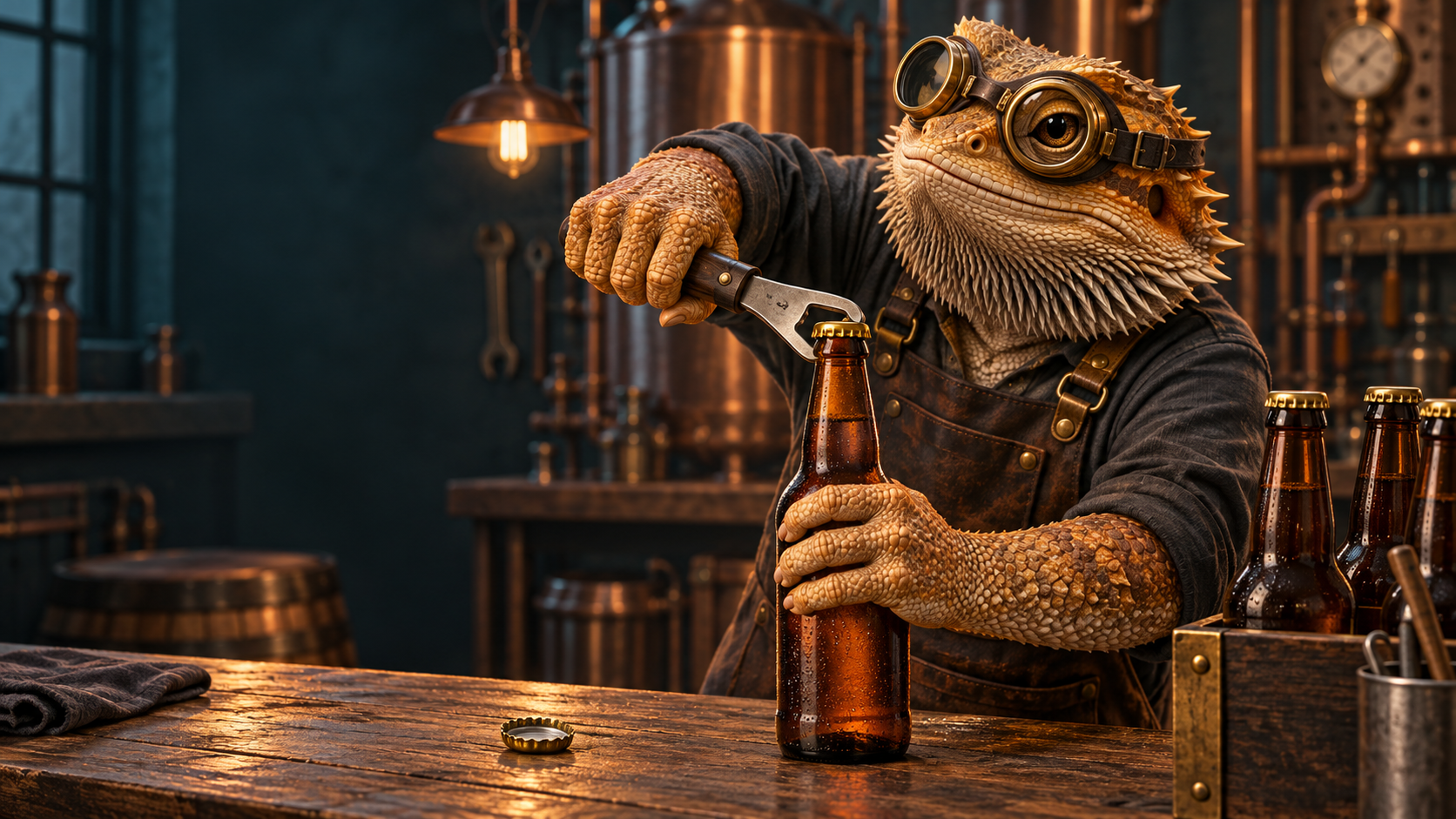
A bottle opener is easy to dismiss as solved technology. Then someone tries to open a crown cap with a thin keychain tool, a decorative wall-mounted novelty, or the wrong angle against a wet bottle. The cap bends, the opener slips, and an ordinary first step becomes more dramatic than it deserves to be.
The useful bottle opener is not the heaviest, most tactical, or most expensive object in a home bar. It is the one that engages the cap reliably, gives your hand enough leverage, and lets you control the motion without bruising your palm or launching the cap across the kitchen.
That is a mechanical question, not a lifestyle question. A crown cap holds by crimping around the bottle finish. A manual opener works by catching under the cap edge, using the bottle lip as a fulcrum, and lifting the cap with a short controlled lever action. The tool does not need much force when those contact points are right. It needs more force when they are not.
Start with cap engagement
The most important feature is the opening end, not the handle decoration. A reliable opener has a defined hook or lip that catches beneath the lower edge of the crown cap while another part of the tool rests securely on top of the cap or bottle finish. That creates a stable pivot.
Look for three things:
- A clear lower hook. The tool should get under the cap edge without hunting for the right angle.
- A broad, stable contact point. The part resting above the cap should not feel like a sharp point digging into the metal.
- Enough stiffness. Thin stamped metal can work, but it should not flex noticeably when opening an ordinary bottle.
Avoid treating the cap like something to pry randomly. If the opener catches only one tiny corner, the cap can deform before it lifts. That does not make the beer dangerous, but it can create a ragged cap, an abrupt motion, and a tool that feels unreliable. Reposition the opener so the hook is fully under the edge and the top contact is stable, then apply pressure in one deliberate movement.
Leverage is what makes a small tool useful
Leverage is the relationship between the force from your hand and the distance from the pivot. A longer handle usually lets you apply the same lifting force with less effort. But longer is not automatically better. An oversized handle can be awkward in a drawer, collide with nearby glasses, or encourage a sweeping motion that makes the bottle hard to control.
For a normal home bar, a palm-length opener with a comfortable handle is a good middle ground. It provides enough distance from the cap to keep knuckles clear, enough grip to make the motion predictable, and little enough bulk to live near the glasses rather than in a specialty-tool bin.
| Opener shape | Where it works well | Tradeoff to notice |
|---|---|---|
| Flat bar or speed opener | Fast, simple operation and easy drawer storage | Can feel thin or abrupt if the edge is poorly shaped |
| Handled manual opener | Comfortable leverage for regular home use | Takes more space and may add decoration that does not help |
| Keychain opener | Emergency use when it is the tool you have | Small grip and short leverage make it less pleasant for repeated use |
| Wall-mounted opener | Fixed location near a fridge or bar cart | Requires deliberate placement and can encourage opening bottles over an unsuitable surface |
None of these shapes changes the underlying job. The best choice is the one you can grip securely and operate without compensating for its design.
Grip and control matter more than speed
Hold the bottle on a stable surface or around the neck with a dry hand. Keep the opener aligned with the cap rather than twisting it sideways. Press the handle smoothly until the cap releases; do not flick the tool or use the bottle against your body as a brace.
The goal is not to make opening beer ceremonial. It is to avoid turning a glass bottle and a metal cap into a surprise. A controlled opener helps in several quiet ways: it keeps the bottle upright, reduces the chance of the cap flying into a glass, and makes the action easy for people with different hand strength or grip comfort.
If the tool slips more than once, inspect the opener instead of blaming the bottle. The hook may be worn, the tool may be too flexible, or the geometry may simply be wrong for your hand. A basic replacement is more useful than a drawer full of novelty openers that all do the same job poorly.
Choose durability you can clean
Stainless steel is a sensible default because it is stiff, easy to wipe down, and indifferent to the occasional splash. A wood, silicone, or wrapped handle can feel nicer in the hand, but it should not trap moisture or leave the tool difficult to clean. Hinges, magnets, and multi-tool attachments are fine only when they solve a real storage problem.
For most homes, a single uncomplicated opener is enough. Keep it in a known location near the refrigerator, serving area, or glassware. A magnetic opener on the side of a refrigerator can be convenient, but confirm it holds securely and does not become a sharp protrusion in a narrow path. A drawer opener works just as well if the drawer is easy to reach while holding a bottle.
This is the same bias toward modest, purposeful gear that makes a compact beer carrier more useful than a giant cooler for a small purchase. The Right Beer Carrier for a Small Taproom Stop applies it to getting unopened beer home safely: match the tool to the ordinary job instead of buying a system for an imaginary maximum.
Put the opener into a sensible serving sequence
Opening the bottle is one part of serving, not a cue to rush. Have a clean, dry glass ready if you plan to pour. A Small Home Bar Needs a Glass-Drying Plan covers the useful handoff between washing and storage. Once the cap is off, pour with the same lack of drama: a controlled glass, a sensible angle, and enough room for foam.
The bottle opener should stay with unopened bottles. Do not use it as a screwdriver, pry bar, or substitute for a can opener. Those jobs damage the contact edge that makes it work well and can leave burrs where your hand goes. If a cap is damaged or a bottle looks compromised, set it aside rather than applying more force in a new direction.
Alcohol also does not make a tool safer. Open bottles before settling into a tasting, keep the work surface clear, and arrange transportation before drinking if a brewery or gathering is involved. Responsible service is mostly ordinary preparation: use the right tool, keep glass stable, and make the next decision while you are still thinking clearly.
Skip the novelty-tax version
There is nothing wrong with an opener that looks good on a bar cart. The problem starts when appearance displaces function. A sculptural handle that cannot be gripped, a magnet that catches caps only sometimes, or a tiny tool designed mainly for a photo is not an upgrade over a plain opener that works every time.
The better bottle opener starts with leverage because leverage makes the job predictable. Choose one with a clear cap hook, a comfortable handle, and enough stiffness to lift cleanly. Store it where you will use it. Then let it disappear into a good serving routine, which is exactly what useful home-bar gear is supposed to do.