A higher-proof whiskey can make a strong first impression. That does not tell you whether the impression comes from aromas you enjoy, a texture you prefer, or simply a larger dose of alcohol in the same-sized sip. “More intense” is a starting observation, not a verdict.
Proof is useful information. It tells you about alcohol concentration and helps you plan a comparison. It does not rank whiskey quality, explain every sensation in the glass, or tell you what strength you will enjoy most.
A better comparison separates two questions: which whiskey do you prefer as bottled, and what changes when you adjust the strength of one whiskey? Those are different experiments. Keep them small, write down the conditions, and resist the urge to turn one evening into a universal theory of bourbon.
What proof tells you
In the United States, proof is twice the alcohol-by-volume percentage: 80 proof is 40% ABV, 100 proof is 50%, and 120 proof is 60%. The TTB distilled-spirits FAQ explains that conversion. Use ABV for comparisons across labels and countries rather than assuming every historical use of “proof” means the same thing.
| Label strength | Alcohol in a 10 mL sample | Useful interpretation |
|---|---|---|
| 40% ABV / 80 US proof | About 4 mL | A baseline concentration, not a quality grade |
| 50% ABV / 100 US proof | About 5 mL | More alcohol in the same sample volume |
| 60% ABV / 120 US proof | About 6 mL | Fifty percent more alcohol than the 40% sample |
These are simple volume calculations using the label ABV. They explain why equal pours are not equal alcohol amounts. They do not establish a safe serving size. The NIAAA standard-drink reference uses about 14 grams of pure alcohol for one US standard drink, illustrated by 1.5 fluid ounces of 40% spirits. Small tasting glasses can still add up.
Plan the total amount before opening bottles. You do not need to finish samples, and a comparison can stop after smelling them. Keep alcohol separate from driving, work, and other activities that require unimpaired judgment.
Choose the question before choosing bottles
For an as-bottled preference, compare two whiskeys at their labeled strengths. That answers a buying or serving question: which presentation do you like? Proof is part of that presentation, alongside the whiskey's other differences.
For a dilution comparison, divide one whiskey into two small samples and add a measured amount of water to one. That controls the starting liquid more closely and lets you observe what the water addition changes.
For a matched-strength comparison, bring the stronger of two whiskeys down to the lower one's ABV. This reduces one obvious difference, but it does not make the liquids identical in every other respect. Their recipes, maturation, blending, and other production choices still differ.
Start with one question per session. The two-whiskey comparison guide covers selecting a manageable pair. Here, the important move is deciding what you will be allowed to conclude before you see which glass you prefer.
Use a setup that does not introduce obvious distractions
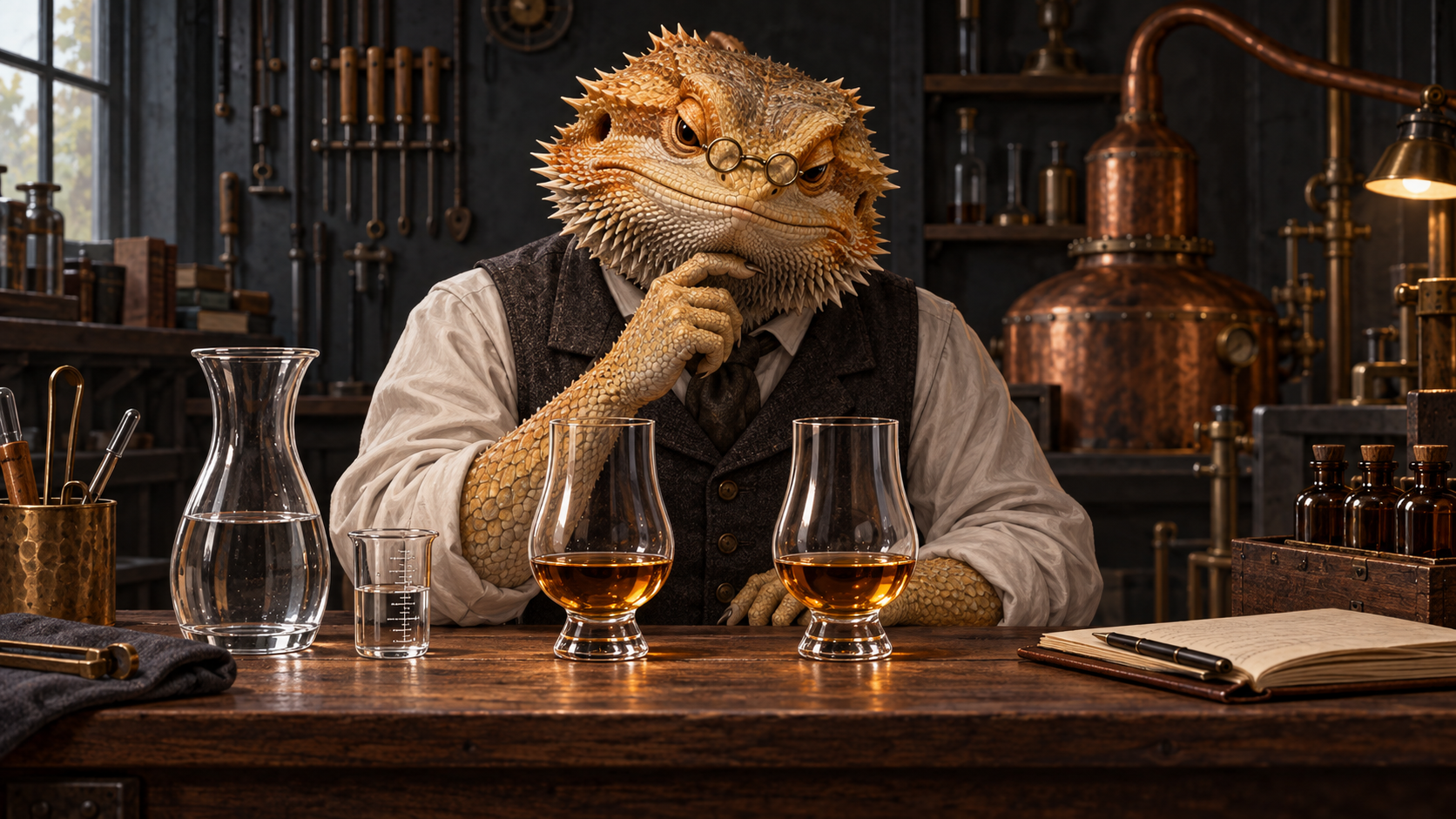
You need two clean, matching glasses, room-temperature drinking water with no obvious odor or flavor, a small graduated measure, and a few notes. A food-safe oral syringe without a needle can measure small water additions more usefully than an unmarked decorative dropper. Reserve it for this purpose and rinse it thoroughly.
Matching glasses reduce differences in opening, bowl shape, and headspace. Similar starting temperatures reduce another distraction. Avoid ice for this exercise: it changes temperature while also introducing a changing amount of water, making your written conditions less useful.
Use modest samples, such as 10 mL in each glass, if you want to try the worked example below. Those quantities are a measurement choice, not a recommended consumption target. Set aside anything you do not want to taste.
Code the glasses underneath if another adult is helping prepare them. This can reduce label expectations, although different fill levels may reveal the diluted sample. A casual home comparison is not a blinded laboratory trial, and it does not need that claim to be useful.
Calculate the water addition before tasting
For a home approximation, use the following relationship with matching units:
water to add = starting whiskey volume × (starting ABV / target ABV − 1)
For 10 mL of 60% ABV whiskey brought to approximately 45% ABV:
10 × (60 / 45 − 1) = 3.33 mL of water
Measure about 3.3 mL of water into that sample. The calculation assumes additive volumes; ethanol-water mixtures do not behave perfectly that way, and label ABV, temperature, and household measuring error also limit precision. This is useful for keeping a tasting repeatable, not for certifying a bottle's strength.
The target must be lower than the starting ABV. Adding water cannot raise a weaker whiskey to match a stronger one. For two bottles, choose a target at or below the weaker whiskey's strength.
Measure before sipping. Once you have removed an unknown amount, the starting volume in the equation is no longer correct. If you want an as-bottled impression first, reserve a separate small portion within your planned total, or conduct that comparison on a different occasion.
Most importantly, adding water does not remove the alcohol already in the glass. It lowers concentration while increasing liquid volume. Drinking the entire diluted sample still means consuming the original sample's alcohol.
Record heat, aroma, texture, and preference separately
Gently mix the diluted sample and let both glasses sit for the same short, recorded interval, such as five minutes. That interval is a consistency choice, not a scientifically optimal resting time. Smell from a comfortable distance before taking any small sip you choose to take.
Use a compact table instead of a numerical score:
| Dimension | What to write |
|---|---|
| Aroma | One or two recognizable impressions, or “unclear” |
| Alcohol sensation | Whether pungency or warmth distracts from other observations |
| Texture | Your impression of body, dryness, or oiliness |
| Flavor and finish | A specific character and whether it remains pleasant |
| Preference | Which presentation you would choose, and why |
“Less distracting warmth, but the finish feels thinner” is a more useful result than “water improved it.” It preserves the tradeoff. “I cannot distinguish them confidently” is also a legitimate result, especially with a small adjustment.
Take breaks and have water available. Do not keep repeating sips to force a confident answer. If the question matters enough to revisit, reverse the order on another day instead of extending the session. The useful tasting-notes guide uses beer examples, but its basic discipline applies: record the observation before polishing it into a story.
Why dilution can change more than heat
Water changes the concentration of aroma compounds as well as ethanol. It also changes the liquid environment from which volatile compounds reach the air above the glass. That is why “water releases the flavor” is too tidy an explanation. Some impressions may become easier to notice while others weaken.
The study Impact of Dilution on Whisky Aroma: A Sensory and Volatile Composition Analysis examined chemical and sensory changes across dilution levels and found differing aroma behavior among whiskies. It supports treating dilution as a meaningful variable. It does not establish one ideal drinking strength for every bottle or every person, and its aroma findings should not be stretched into a universal verdict about palate or enjoyment.
Your comparison has similar limits on a smaller scale. A preferred diluted sample tells you something about that whiskey, that preparation, and your preference. It does not prove that all high-proof whiskey needs water or that a lower-proof bottling from the same producer would taste identical.
Make the result useful at the next pour
Keep the practical outcome: the bottle, labeled ABV, measured starting volume, water addition, and a sentence about the tradeoff. If you preferred it unchanged, record that. If you liked the aroma after dilution but preferred the original texture, preserve both observations instead of inventing a winner.
For a purchase, ask whether you enjoy the presentation you will actually serve. A higher-proof bottle can offer room to adjust strength, but that flexibility has little value if you dislike the underlying whiskey or never want to measure water. An enjoyable lower-proof bottle needs no apology.
Proof belongs in your notes because it helps explain the conditions. Flavor and preference belong in separate fields because they answer different questions. Use a small comparison to find a serving choice you can repeat, then put the measuring tools away. The goal is a better glass, not a bigger tasting.