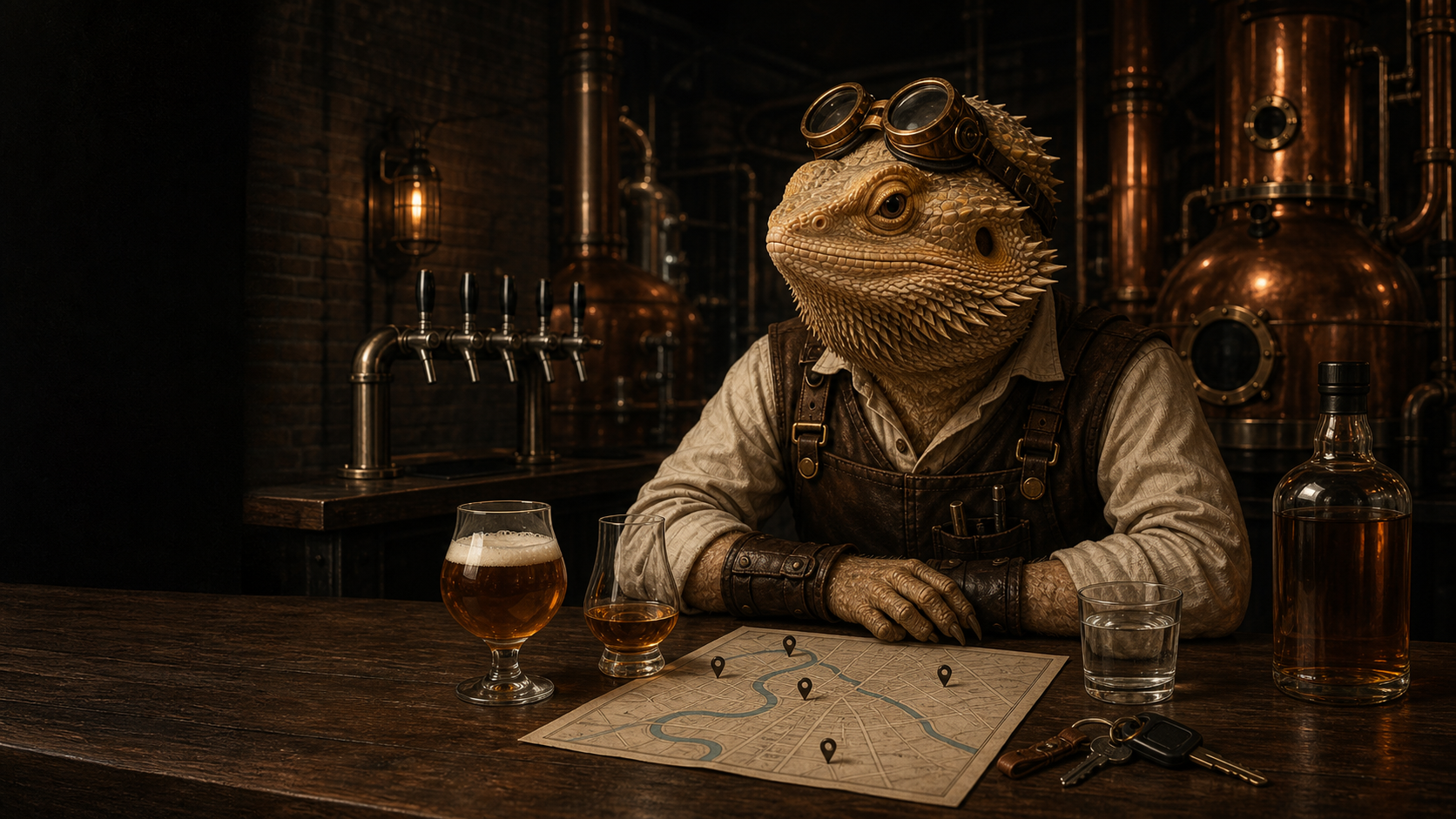
Dayton makes more sense as a beer and whiskey visit when you stop trying to turn it into a checklist. There are breweries with distinct approaches, local distilleries with different reasons to visit, and enough geography that a loosely planned afternoon can become mostly driving, parking, and deciding what to do next.
The useful approach is to choose a purpose for each stop. Are you comparing a brewery's house style, looking for a meal with one good pint, trying a local spirit, or buying a bottle to take home? That one decision keeps a visit from becoming an accidental endurance event. It also leaves enough attention to notice the beer or whiskey in front of you.
This is a planning guide, not a claim of personal visits or a permanent list of what is on tap. Confirm current hours, menus, tours, and event schedules with each operator before you go.
Build the route around one tasting question
The best question is small. It might be “What does this brewery do with lager and IPA?” or “Do I prefer a local bourbon or rye as a home bottle?” Avoid “How many places can I fit in before dinner?” That question produces a worse answer every time.
For a Dayton-area visit, use one of these shapes:
| Visit shape | Good objective | Keep it responsible by |
|---|---|---|
| One brewery and a meal | Learn a house beer style without rushing | Ordering a modest pour, food, and water |
| Two nearby beer stops | Compare two approaches to a shared style | Splitting small pours and using a designated driver or ride |
| Distillery-focused afternoon | Explore one producer's whiskey and production story | Booking or confirming the experience first and not stacking tastings |
| Bottle-shopping stop | Buy a considered bottle for later | Tasting only if transport and work obligations are already closed |
The date on a travel guide should never substitute for a live check. A tasting room may close for a private event, change kitchen hours, or have a different weekend schedule. Call or use the official site, then make transportation part of the reservation rather than an afterthought.
Beer: choose the kind of brewery visit you want
Warped Wing's Dayton taproom is a useful downtown-oriented stop for someone who wants a brewery experience with food and a defined location: the operator lists it at 26 Wyandot Street and notes that seating is first come, first served. The brewery frames its beer around Dayton's innovation history, including the Wright brothers' wing-warping reference in its name. That makes it a good place to order one representative house beer, perhaps alongside something lower intensity, rather than chasing every seasonal option.
Branch & Bone Artisan Ales is another Dayton option, describing its brewing as a mix of European traditions and modern American approaches. That is a reason to arrive with a style question. If the current list includes a lager, a mixed-fermentation beer, or a hop-forward beer you normally enjoy, choose a small comparison that tells you something about the brewery's range. Do not infer the entire program from one unusually strong or unusual release.
For a more meal-oriented taproom, Eudora Brewing Company lists a Dayton-area taproom and kitchen at 3022 Wilmington Pike, with published days and hours that should still be rechecked before travel. The practical appeal is not simply that food is available; it is that a meal can slow the pace and make a single-stop evening more sensible. Food, water, and a planned ride are part of the tasting system, not accessories.
If you are new to a brewery, do not begin with the highest-ABV release. Start with the beer that staff identifies as fresh, representative, or especially well suited to your stated preference. A small flight can be useful when it compares three related beers; a large flight of unrelated strong pours is mostly a way to make the last samples harder to judge. A Beerded Engineer’s Guide to Visiting a Brewery has the practical sequence.
Whiskey: distinguish a local producer visit from a bottle hunt
For a distillery visit closer to Dayton proper, Belle of Dayton presents both tours and a bar, and identifies Detrick Straight Bourbon Whiskey as an aged, local product. A tour can add useful context about what the producer makes, but it should not become a reason to turn the day into a string of pours. If the point is whiskey, ask about the particular product, its proof, and whether it is intended for sipping or cocktails; then select a modest pour or a bottle decision, not both by default.
Indian Creek Distillery in the broader Dayton area offers a different kind of stop: its site describes an early-American artisan farm distillery and lists its own current operating days. It also offers tours and produces rye and other frontier-style whiskeys. Its historic framing is interesting, but the useful tasting discipline remains ordinary: compare one expression with water available, note whether you prefer its grain character and proof, and decide later whether it deserves space in your home bar.
That separation is especially important with whiskey. A distillery's historical story is part of the visit, but it is not proof that every bottle will suit your taste or budget. Use the same decision process you would use at home: identify the exact whiskey, know the proof and bottle size, and avoid treating scarcity or local provenance as a verdict. Bourbon vs Rye: What Changes in the Glass? is a good reset before choosing between the two styles.
A better order of operations
The order below makes room for both observation and enjoyment:
- Confirm a single primary destination and one nearby fallback before leaving.
- Eat before tasting or choose a place where a real meal is part of the plan.
- Arrange a designated driver or ride before the first pour; do not rely on a late decision.
- Start with the lighter, lower-proof, or more familiar pour.
- Drink water between samples and stop when comparison has ceased to be useful.
- If you buy beer or whiskey, transport it safely and wait to open it when you can taste it without a schedule, drive, or work obligation afterward.
This is not moral theater. It is how you preserve the useful part of a local tasting: paying enough attention to know what you liked and returning safely. It is also why beer and whiskey should be an evening plan after remote work, never the location for the workday itself.
What to bring home, if anything
The right answer may be nothing. A traveler with a flight, a warm car, or a crowded schedule does not need to turn every good stop into a purchase. If you do buy beer, favor a small amount you can protect from heat and enjoy soon, especially for hop-forward styles. If you buy whiskey, choose a bottle only after you can identify why it fits your taste or a specific cocktail use.
Take a brief note instead of relying on a memory shaped by the room, the company, or the third stop. Record the producer, beer or whiskey, style, proof if relevant, the thing you noticed, and whether you would choose it again. A Beerded Engineer’s Guide to Visiting a Brewery uses a similarly small method: choose a purpose, make a focused order, and leave enough room to notice what you are drinking.
Dayton does not need a maximal itinerary to be rewarding. Pick a brewery or distillery with a reason behind it, respect the moving pieces around hours and transportation, taste a few things deliberately, and leave the rest for a future visit. That is a better way to learn what a local drinking scene does well—and a much better way to enjoy the next day.